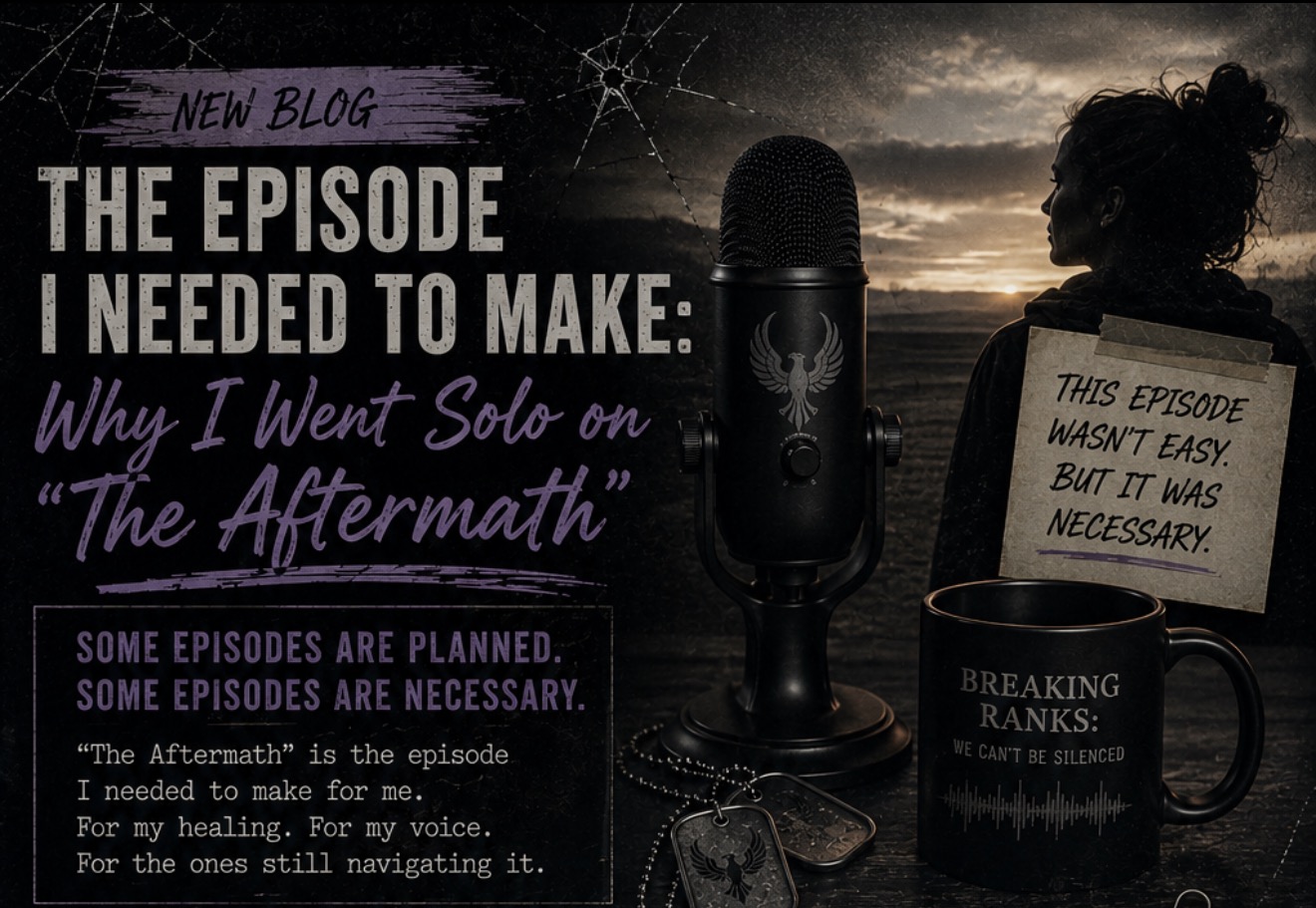
The Episode I Needed to Make: Why I Went Solo on "The Aftermath"
I almost didn’t do this episode as a solo.
I had been working with survivors, most were not ready to share just yet, but when they are, they will be back ready to rise.. That’s what Breaking Ranks is about…amplifying the people who’ve been silenced. But as I was sitting with dozens of conversations, dozens of experiences, I kept hearing the same thread: the part after you report is somehow worse than what came before.
That’s not a story someone else needed to tell. That was mine.
The decision to go solo came from a place of honesty. I realized I couldn’t ask people to be vulnerable about their aftermath without being willing to walk through mine. Not as the host. Not as the person holding the microphone. But as someone who’s been disoriented, labeled, and sidelined by a system that claims to have all the answers.
Recording this episode was different. Usually, I’m focused on listening, on creating space for someone else’s story. This time, I had to sit with my own. And that was uncomfortable in a way I didn’t expect.
What surprised me most wasn’t the difficulty of articulating the experience…it was realizing how many people need permission to name what the aftermath actually is. We talk about trauma. We talk about reporting. But nobody really talks about LIMDU (Limited Duty), the medboard process, or that weird identity crisis where you’re no longer the person you were but you’re not sure who you’re supposed to become. It’s like the system has a flowchart, but the flowchart is missing half the steps. Each person’s story and aftermath is different, but a lot share similar pieces. As this podcast continues to expose the truths we will srtart seeing the patterns of the system.
As I was recording, I kept thinking about all the messages I’ve received…people saying they felt alone, that nobody understood what came after. And I realized: that was the story that needed to be told. Not just the incident. Not just the reporting. But the disorienting, exhausting, sometimes infuriating process of trying to move forward in a system that doesn’t seem to know what to do with you once you’ve spoken up.
The phrase “broken compass in a system that lost the map” came to me while I was recording, and I had to pause because it just fit. That’s what it feels like. You’re trying to navigate something that doesn’t have clear directions, where the rules seem to change depending on who’s in the room, and where speaking up somehow puts a target on your back instead of protecting you.
This episode is raw. It’s not polished. It’s me thinking out loud about what nobody prepares you for, and honestly, that felt necessary.
If you’ve been through this…if you’ve reported something and felt the aftermath hit harder than the original incident…I want you to know you’re not alone. And more than that, I want you to know that your experience matters.
That’s why this episode exists.
Listen to the full conversation on Breaking Ranks: We Can’t Be Silenced.